

NOVA MCGILL
Contributor
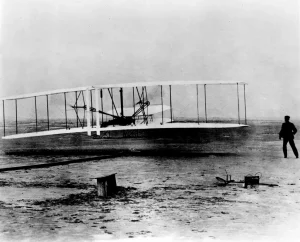
The advent of human flight is among the marvelous feats in the fields of engineering and innovation. The credit for this historical flight of the first airplane goes to Orville and Wilbur Wright, who after repeated trials, successfully conducted a powered flight on December 17, 1903 at Kitty Hawk, North Carolina. This event marked not only a significant milestone in aviation history but also symbolized humanity’s relentless quest for exploration and advancement.
The Wright brothers were bicycle makers who, after studying numerous aeronautical ideas and early inventors, became enthralled with flight. In a very methodical approach, they did a great deal of research and tested gliders innumerable times before attempting powered flight. They set up a succession of test flights, documenting their observations with great detail to learn about lift, control, and propulsion. It was from this detailed learning of the principles of lift, control, and propulsion that the Wright Flyer was created, having a wingspan of 40 feet and 4 inches, a lightweight frame, in addition to a powerful engine designed and built by themselves.
On that historical day in December, Orville Wright took the Flyer into the air to mark the first powered flight in history, which lasted 12 seconds and covered a distance of 120 feet. But more than being a singular event, it provided the impetus for a vast, transformative movement in the form of transportation, changing the tempo of travel and connectivity around the world. The successful flight by the Wright brothers proved that controlled, powered flight was indeed possible, as that opened the door to further improvement in aviation technology.
Over the years that followed, the concepts laid down by the Wright brothers sparked an era of invention, culminating in the creation of aircraft of an advanced nature. In the 20th century, aviation began to grow and expand from initially being made up of frail, wood-and-cloth contraptions to now stronger, full-metal planes that could traverse across entire oceans and continents. Everything regarding this development was going to have wide-ranging effects: military, commercial, and social. This opened up many industries to speedy travel, helped in international trade, and enabled cultural exchange across the world.
Photo from amazingworld adventures.com