

NOVA MCGILL
Contributor
The surprise attack by the Imperial Japanese Navy on December 7, 1941, on Pearl Harbor formed a turning point in American history, one which would eventually plunge the United States into World War II. The surprise military attack targeted the U.S. Pacific Fleet while allowing Japan to advance its territorial expansion in Southeast Asia. The outcome of this surprise attack not only altered the way the war was being conducted but also rearranged the socio-political dynamics of America.
During this period preceding the attack, tensions were escalating between America and Japan because the latter continued its militaristic expansion across Asia and the Pacific. The diplomatic negotiations had therefore collapsed due to the fact that, while Japan tried to acquire resources and territory, the United States placed economic sanctions and embargoes upon it, especially regarding oil exports. All this created a part of an environment filled with mistrust and expectation of conflict.
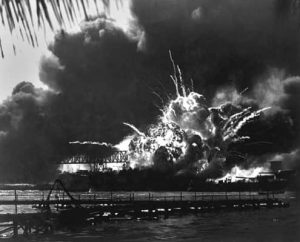
On the morning of December 7, 1941 at 7:48 a.m., Japanese aircraft began their first wave of the surprise attack upon the naval base at Pearl Harbor on the island of Oahu in Hawaii. For nearly a two-hour period, over 350 Japanese aircraft targeted battleships, airfields, and other military installations. The result was calamitous: eight battleships were sunk or severely damaged, nearly 200 aircraft destroyed, and more than 2,400 Americans killed, while a large number were seriously injured. The immediate result of the bombing was to send shock waves of incredulity throughout the American nation. Up until the time of the attack, feelings of isolationism had been quite strong; the attack consolidated a national sense of cohesion and mobilized popular appeal for declaring war. On December 8, 1941, President Franklin D. Roosevelt gave a speech to Congress in which he referred to December 7 as “a date which will live in infamy.” This not only summed up the feelings of outrage but initiated formal involvement by the United States in World War II, since Congress quickly declared war upon Japan. The attack at Pearl Harbor sent wide ripples beyond the shores of Hawaii. The attack catalyzed American industry and military forces into mobilization, plunging the U.S. into full-scale war production. It transformed civilians into active participants of the war through such means as enlistment into the armed forces and contributions to war-related industries. The attack even reshaped geopolitical alliances and strategies that would eventuate in the Allies’ joint efforts against the Axis powers. More specifically, the bombing of Pearl Harbor was a jolting indication of just how tenuous peace is, and how truly unpredictable international relations can be. The incident not only signaled an unprecedented escalation of global conflict, but also ushered in a new chapter in American history-a chapter typified by military interventionism and internationalist policy. What happened on that day still reverberates today in continuous debates about national security, diplomacy, and the civic memory of a nation forged in the crucible of attack.
Photo from www.pearlharbourtours.com