

NOVA MCGILL
Contributor
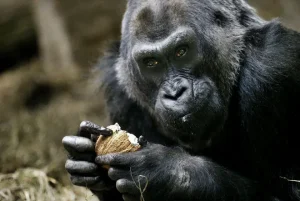
Colo’s birth brought a historical change in how humans treated, studied, and showed empathy for the great apes. This occurred on December 22, 1956 at the Columbus Zoo and Aquarium in Ohio, as a baby western lowland gorilla named Colo was born. It was a time when gorillas were thought to be aggressive, mysterious, and impossible to successfully breed in a setting other than their own natural habitats.
Before Colo’s birth, gorillas in zoos on average did not live long, and procreation was considered a long shot. This was because there was no existing knowledge on how to provide for gorillas’ sophisticated needs in zoos. This is where stereotypes began: gorillas being either ferocious beasts or being too sensitive to make it through a period of captivity alive seemed to be an argument against them surviving long-term. These stereotypes have been perpetuated over time in pop culture as gorillas have long been portrayed as evil, ferocious beasts, and not as the sophisticated beings in which they are.
Colo was born to parents Millie and Mac, both of whom were wild-caught gorillas. Survival was not assured. Of particular importance was the fact that Millie was inexperienced as a mother and did not seem particularly interested in Colo, a condition exacerbated by the fact that she was zoo held. In fact, Colo was hand-raised by zoo personnel using bottles and through heavy human interaction. Although hand-raised animals are now raised using much more carefully considered methods and in light of the effect on animal behavior, hand-raising, like Colo, saved the gorilla’s life because it enabled her to reach adulthood as a living testament that gorillas can indeed survive the early stages of development in a zoo setting.
Colo, now mature, found herself a prized subject for scientific study. Much was learned from her behavior, physiological development, and interactions within this new environment. In time, the trend of housing gorillas in more naturalistic enclosures and grouping began to get underway, in recognition of the fact they are extremely social creatures. The impact of Colo’s life was leading to a transition towards considering zoo animals not just objects but rather individuals with psychological needs.
Colo also made important contributions to public education. Millions of visitors watched her perform at the Columbus Zoo, where they encountered a gorilla for the first time. Contrary to their frightening expectation, Colo proved to be calm, curious, and intelligent. Seeing Colo made the public view gorillas in a different way, which was important for the growth of conservation in the latter half of the last century. This had important implications for the understanding of the species which this chapter discusses.
Colo also played a role, apart from her symbolic relevance, in ensuring the survival of her species. Colo gave birth to three offspring and this made her a pioneer in the breeding of gorillas in captivity. Later, this process proved pivotal since the population of gorillas in the wild was threatened by habitat destruction, hunting, and diseases. Though breeding can never compensate for the protection of species and organisms living in the wild, it has played a significant role in ensuring the survival of the species.
Colo’s long life added to the success that had been achieved in caring for animals. At the time of her death in 2017, she was thought to be the oldest gorilla ever recorded. Another animal, Koko, had a similar life to Colo but with slightly different experiences in terms of animal care and development. Koko was also born in captivity and was the first lowland gorilla in the program. However, she suffered more from loneliness compared to Colo.
Photo by Fred Squillante